
#Adult Dependent Relative Visa
Expert legal support helping couples navigate UK immigration rules,
What is an Adult Dependent Relative Visa?
The Adult Dependent Relative (ADR) Visa is a specialised immigration route that allows elderly or vulnerable family members to join their close relatives in the United Kingdom when they require a high level of ongoing personal care that cannot reasonably be accessed in their home country.This visa is specifically intended for individuals who, due to advanced age, serious medical conditions, or physical or mental disability, are no longer able to live independently and must rely on the day-to-day support of a close family member. The route recognises the importance of family unity, particularly where the applicant’s wellbeing and quality of life depend on being cared for by their relatives in the UK.To qualify, applicants must demonstrate that they require long-term personal care to perform essential everyday tasks such as washing, dressing, cooking, or mobility. In addition, they must provide compelling evidence that such care is either unavailable, inadequate, or unaffordable in their country of residence, even with the practical and financial support of their UK-based family members.
Who Can Apply?
You may be eligible if you are a close relative of a UK-based sponsor, such as:
- Parent or grandparent
- Adult child or sibling (in limited circumstances)
The UK-based sponsor must be:
- A British citizen
- Settled in the UK (Indefinite Leave to Remain – ILR)
- Holding refugee status or humanitarian protection
Key Eligibility Requirements
To qualify for an Adult Dependent Relative Visa, you must demonstrate that:
- You require long-term personal care due to age, illness, or disability
- The required level of care is not available or affordable in your home country
- You cannot reasonably obtain care from family members or services locally
- our UK-based sponsor can fully support and accommodate you without relying on public funds
- Submit all required documents in the correct format
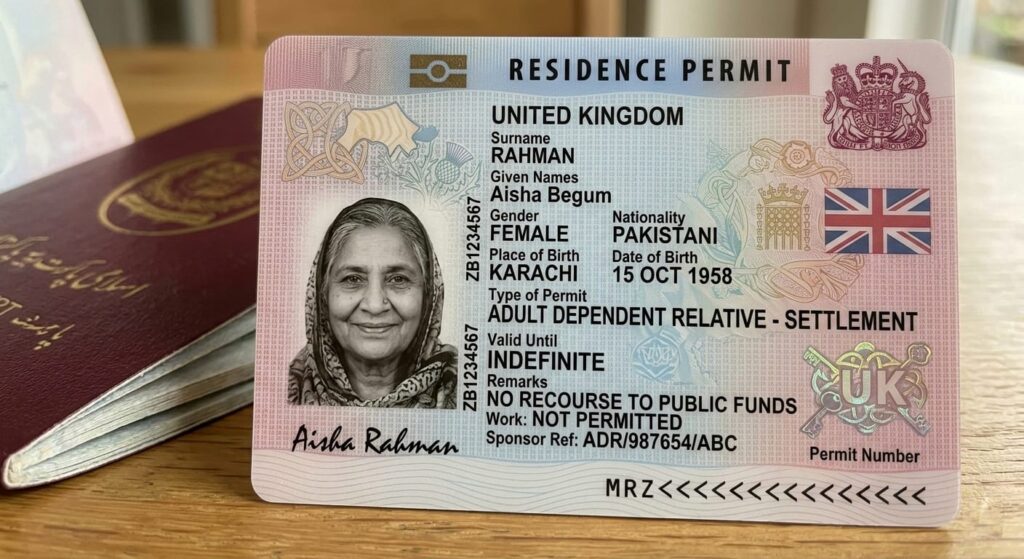
What is Considered “Long-Term Personal Care”?
Long-term personal care refers to the continuous assistance required by an individual to manage essential day-to-day activities due to age, illness, or disability. This level of care typically includes support with basic personal tasks such as washing and bathing, dressing, preparing and consuming meals, and maintaining mobility. It may also involve help with routine daily living activities, ensuring the individual’s safety, hygiene, and overall wellbeing. The need for such care must usually be supported by medical evidence, demonstrating that the applicant is unable to perform these tasks independently and requires ongoing assistance from another person.
Financial Requirement (Sponsor)
The UK sponsor must prove that they can:
- Maintain and accommodate the applicant
- Provide care without access to public funds
- Cover all living and medical costs
Evidence includes:
- Bank statements
- Payslips or proof of income
- Accommodation details
Accommodation Requirement
You must show that suitable accommodation is available in the UK:
- Adequate space for the applicant
- Safe and suitable living conditions
- Proof of ownership or tenancy
Required Documents
- Valid passport
- Medical reports confirming care needs
- Evidence that care is unavailable or unaffordable in home country
- Proof of relationship to sponsor
- Sponsor’s financial documents
- Accommodation proof
- Statements explaining the situation
Visa Outcome
- If approved, the applicant is usually granted Indefinite Leave to Remain (ILR) immediately
- This allows them to live permanently in the UK
Common Reasons for Refusal
- Insufficient medical evidence
- Failure to prove care is unavailable in home country
- Weak financial evidence from sponsor
- Incomplete or inconsistent documentation
Strict Immigration Standard
The ADR Visa is one of the most difficult UK visas to obtain due to its strict requirements. Applications are carefully assessed, and only those with clear, compelling, and well-documented evidence are likely to succeed.
The Home Office places strong emphasis on whether the applicant can reasonably receive care in their home country before considering approval.

Common Challenges in ADR Applications
Applicants often face difficulties such as:
- Proving that adequate care is truly unavailable in the home country
- Meeting the high evidential threshold set by UKVI
- Providing clear and consistent medical documentation
- Demonstrating long-term dependency rather than temporary illness
Human Rights Consideration
In some cases, the ADR application may also involve human rights arguments. If refusing the application would result in a serious breach of the applicant’s right to family life or lead to unacceptable hardship, this may be taken into consideration.
However, such cases require strong and compelling evidence.
Legal Importance of the ADR Route
The Adult Dependent Relative Visa is one of the most legally complex immigration categories in the UK. It is strictly controlled to ensure that only genuine and exceptional cases are approved.
Due to its complexity, careful preparation and detailed documentation are essential for a successful outcome.
How the ADR Visa is Different from Other Family Visas
The Adult Dependent Relative Visa is significantly different from standard UK family visa routes such as Spouse, Partner, or Child visas. Unlike those categories, which primarily focus on relationship-based immigration, the ADR route is based on dependency and medical need.
This means approval is not granted simply on the basis of family ties, but only where there is clear evidence that the applicant requires continuous personal care that cannot be provided anywhere else except in the UK.
Role of Medical Evidence in ADR Applications
Medical documentation plays a central role in determining the success of an ADR application. The Home Office relies heavily on independent medical reports to assess the level of dependency.
Strong medical evidence should clearly explain:
- The applicant’s diagnosis and medical condition
- The level of daily care required
- Whether the condition is long-term or permanent
- The impact on daily functioning without assistance
- Professional opinion on care needs and risks